
The age we live in will undoubtedly be defined by artificial intelligence (AI). Europe just has to make a choice between stepping aside and falling behind or getting ahead now and acting as a global AI leader.
The digital age is already creating a rapid economic, societal and political flux across Europe. But what challenges does it create and how can we best move forward? An AI-focused panel dissected this question at ALDE Party Council in Dublin on 13-14 November.
ALDE Party President & Shadow Rapporteur for the AI Act and AI Omnibus Svenja Hahn MEP currently plays a huge role in how Europe legislates AI. Drawing on her experience, she told the panel:
“We cannot build an economy of tomorrow with the mindset of yesterday. AI is fundamentally changing how we work and how we live.” Hahn called for Europe to shape the AI it wants with democratic frameworks.
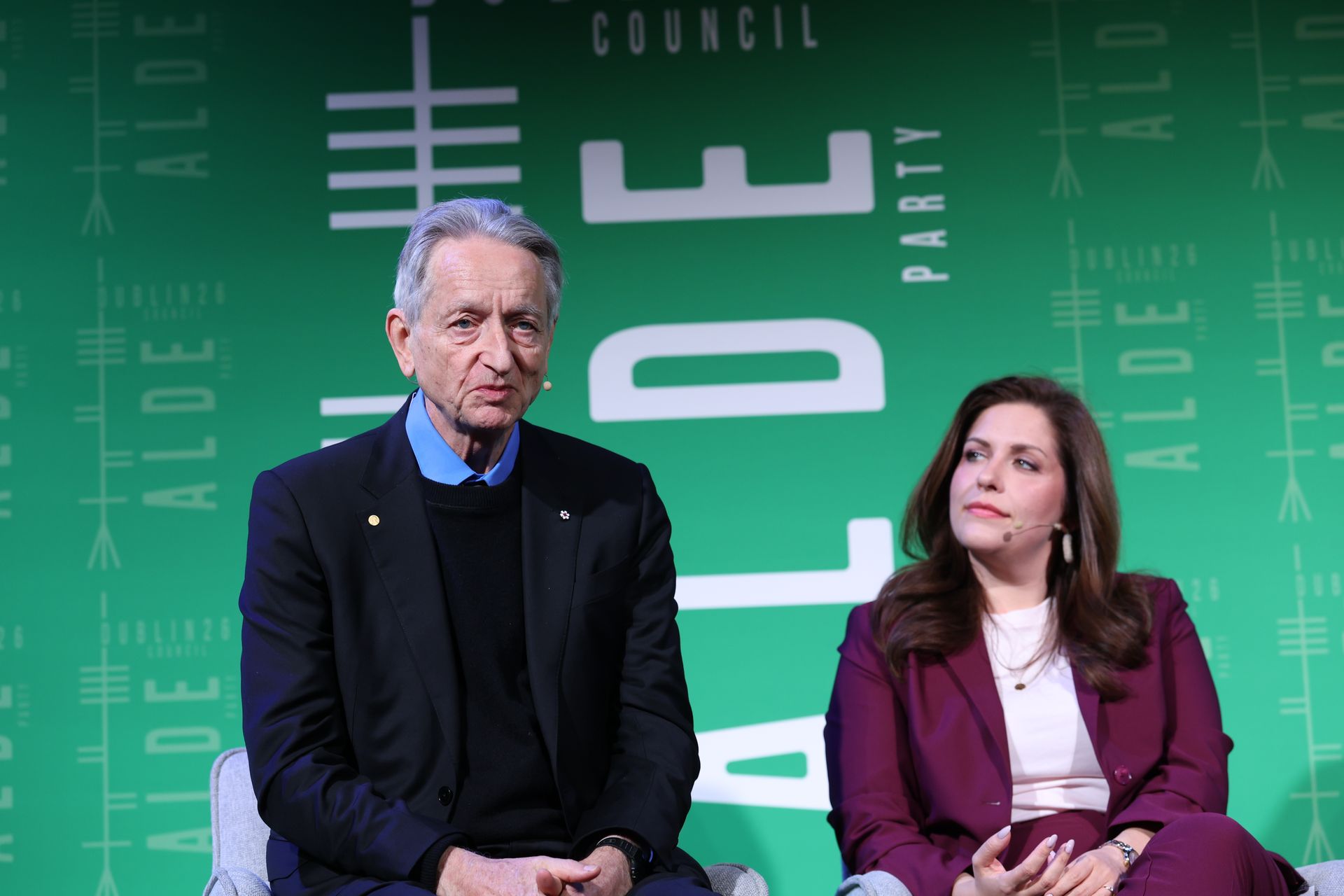
2024 Nobel Prize laureate and “Godfather of AI” Professor Geoffrey Hinton had briefed Europe’s leaders at an informal European Council meeting earlier that day. He then joined our panel, giving liberals an honest assessment about where AI is going, predicting that we are two to ten years away from superintelligent AI.
“We are going to develop super intelligent AI. It's coming quite quickly and nobody knows how we can stay in control of it. We're sort of at a point in history when there's a large asteroid hurtling towards the Earth and it's going to get here in between two and 10 years," Hinton warned.
Hinton spoke about the dangers of "tech feudalism" pushing for rapid development with no regulation. He says one of the biggest threats from AI is bad people misusing it: from Russian attacks and lethal viruses to cyberwars and massive unemployment.
Liberals are therefore calling for Europe to invest in safe AI for the future. Hinton proposed an idea coming in the form of a vaccine analogy. If we build up our cognitive immune systems by showing as many AI-generated videos as possible, we can become immunised to the threat of disinformation.
AI is not politically neutral and can be swayed by the political ideology of its user. Citizens must therefore be equipped to navigate the AI age. Regulation alone cannot protect democracy from disinformation. Digital literacy, critical thinking and public awareness must become essential parts of Europe's response toolkit.
“As liberals we don't like to overregulate; we like to let people do their own thing within the democratic framework that we have. But we have to protect the democratic framework too,” Byrne said, with Poturaiev also warning that AI can be also used by our enemies: "The same technological revolution that empowers our economies also gives hostile actors new instruments for attacking our societies."
The panel clearly acknowledged that AI is here to stay, and will be a crucial part of Europe’s economy for years to come. So, liberals must embrace the role of shaping it and fill the vacuum as the world’s leading safe AI power.
Liberals must ensure that the AI revolution strengthens freedom, democracy and opportunity rather than undermining them. Europe should not simply be a market for technologies developed elsewhere, or a regulator of other people's ambitions. It should become a global leader in building AI that serves humanity.